Behind the Scenes: How Sociocracy Circles Shape Rooted Northwest
When people first learn about Rooted Northwest, they often ask questions like:
- How do decisions actually get made?
- Who’s in charge?
- How do you avoid meetings that go nowhere—or conflict that lingers?
Behind the scenes, Rooted Northwest uses a governance system called sociocracy to help answer those questions in a thoughtful, transparent way. While the word itself can sound academic, the practice is surprisingly practical—and deeply human.
At its core, sociocracy helps us share responsibility, make clear decisions, and keep power distributed, so the community can grow without burning people out or relying on a few voices to carry everything.
This article offers a friendly look at how sociocracy works at Rooted Northwest, and how our circle structure supports both efficiency and care.
What Is Sociocracy, Really?
Sociocracy is a governance approach designed for groups that want to collaborate effectively while honoring everyone’s voice. Rather than relying on majority votes or informal power dynamics, sociocracy emphasizes:
- Clear roles and responsibilities
- Transparent decision-making
- Consent rather than consensus
- Ongoing learning and feedback
At Rooted Northwest, we follow the practices of Sociocracy for All, drawing guidance from Many Voices, One Song by Ted Rau and Jerry Koch-Gonzalez. While there are other systems out there (like Holacracy), sociocracy aligns best with our values as an intentional, land-based community.
Circles: The Heart of Decision-Making
The basic building block of sociocracy at Rooted Northwest is the circle.
A circle is a small group of members (usually 5–7 people) who share responsibility for a specific area of community life. Each circle has:
- An aim – what the circle is trying to accomplish
- A domain – what decisions the circle is empowered to make
This structure allows decisions to be made by the people closest to the work, rather than funneling everything through one central body.
Examples of Rooted Northwest Circles
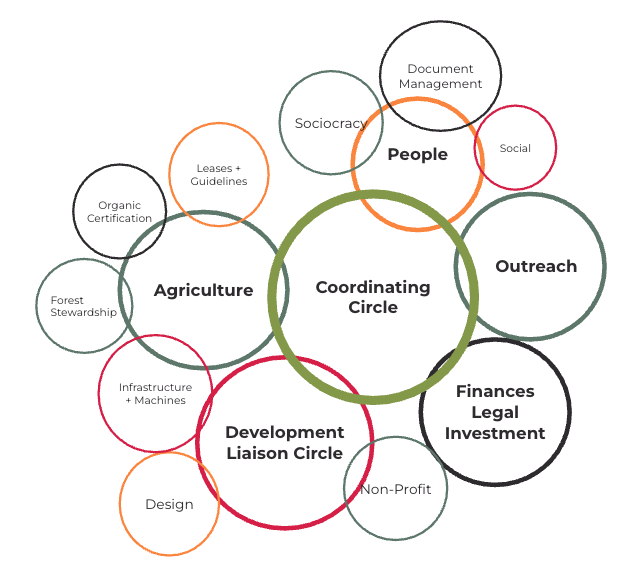
At the broadest level, we have a Coordinating Circle, which helps align the whole community. From there, several primary circles focus on key areas, including:
- Agriculture
- People
- Outreach
- Finance
- Development Liaison
Each of these circles can form subcircles as needed—for example, agriculture subcircles focused on forest stewardship or organic certification.
Whenever possible, decisions are pushed outward to the smallest, most relevant circle. This keeps things moving while avoiding unnecessary bottlenecks.
How Circles Stay Connected
While circles operate with autonomy, they’re not siloed.
Rooted Northwest uses a system called linking, which ensures information flows between circles:
- Each primary circle is double-linked to the Coordinating Circle
- This means both a leader and a delegate from each circle participate in the parent circle
- Subcircles always maintain at least a single link back to their parent circle
This structure balances independence with alignment, so decisions stay connected to the bigger picture.
Consent, Not Consensus
One of the most misunderstood aspects of sociocracy is consent-based decision-making.
Consent does not mean everyone has to love or fully agree with a proposal. Instead, a decision moves forward when no one has a reasoned objection—meaning:
- The proposal doesn’t conflict with the circle’s aim or domain
- It doesn’t contain major flaws or missing pieces
- It won’t prevent someone from doing their work
- It includes a way to evaluate whether it’s working
This approach allows groups to move forward thoughtfully without getting stuck in endless discussion or watered-down compromises.
Who Makes Decisions?
Only circle members (sometimes called circleites) participate in consent decisions.
Explorers and prospective members are welcome to:
- Observe circle meetings
- Participate in discussions
- Support work between meetings
But decision-making authority comes with full membership, ensuring accountability and clarity.
Importantly, Rooted Northwest operates with individual participation, not household voting. This supports equity and avoids informal power dynamics.
Roles That Support the Group
Each circle selects specific roles—typically for one-year terms—to support smooth collaboration. These often include:
- Leader – keeps the circle aligned with its aim
- Delegate – connects the circle to the parent circle
- Facilitator – supports effective meetings
- Log Keeper – tracks decisions and documentation
Roles are selected using a structured process, and they rotate over time to prevent burnout and encourage shared leadership.
Training, Support, and Compassionate Communication
Sociocracy isn’t something people are expected to “just know.”
At Rooted Northwest:
- New members receive introductory sociocracy training
- Members learn non-violent (compassionate) communication practices
- Circles receive templates, coaching, and process support when neede
At the same time, sociocracy honors circle autonomy. Circles can adapt how they work—as long as everyone consents—allowing flexibility as the community evolves.
Why This Matters
Sociocracy isn’t about structure for structure’s sake.
It’s about creating:
- Clear pathways for participation
- Fair and transparent decisions
- A culture where responsibility is shared
- Systems that can grow with the community
By using circles and consent, Rooted Northwest is building governance that reflects the same care we bring to the land, our homes, and our relationships.